Project at a Glance
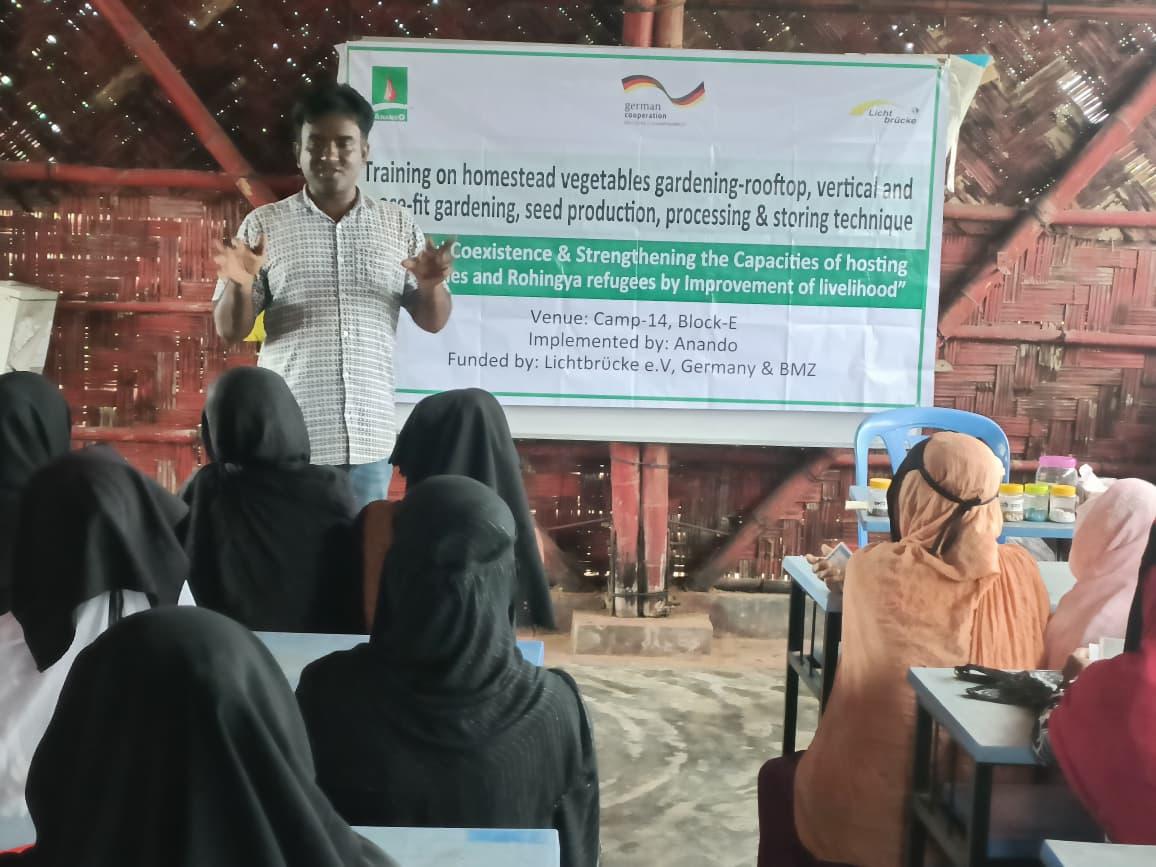
Project Title | Peaceful Coexistence & Strengthening the Capacities of Hosting Communities and Rohingya Refugees by Improvement of Livelihood |
Duration | November 2025 – July 2029 (45 months) |
Locations | Ukhiya Upazila, Cox's Bazar district — Rohingya Camp 14 and host communities in Rajapalang and Ratnapalong Unions |
Funded By | German Federal Ministry for Economic Cooperation and Development (BMZ) through its German private agency partnership |
Implemented By | ANANDO — Promotion of Culture and Youth Resource Development |
Direct Participants | 1,500 households (7,500 people) centred on women and girls, drawn from both Rohingya and host communities — prioritising women-headed, widowed and divorced women's households, families in extreme poverty and ethnic minorities |
Indirect Reach | 4,500 adjacent households (22,500 people), with wider awareness and peacebuilding activities reaching around 45,000 people across the host and Rohingya communities |
Sectors | Livelihoods and skills development, climate-resilient agriculture, nutrition, women's economic empowerment, peacebuilding and social cohesion, protection and GBV prevention |
Why This Project
Ukhiya hosts some of the largest and most densely populated refugee camps in the world. Around 95% of Rohingya families remain dependent on humanitarian assistance, while host communities have absorbed years of economic pressure — depressed wages, rising prices and intense competition for work. Women in both communities carry the heaviest burden: limited income opportunities, exclusion from household decision-making, and high rates of gender-based and intimate partner violence. With few vocational pathways and growing strain between communities, targeted support for skills, incomes and dialogue is essential to sustain peaceful coexistence. The project responds to this need in line with the Government of Bangladesh's framework on skills development for Rohingya refugees and host communities, which promotes portable skills that can also support voluntary return and sustainable reintegration in Myanmar.
Project Goal
1,500 households belonging to women and girls from Rohingya and host communities in Ukhiya increase their household income through climate-resilient agriculture and vocational training, while women's participation in livelihoods and equality are promoted for better cohesion and peace — contributing to improved knowledge, skills, gender equality and social cohesion across both communities.
Specific Objectives
• Resilient livelihoods: Increased gender-sensitive, climate-resilient and nutrition-sensitive livelihood opportunities for the 1,500 target households.
• Skills and income: Increased income, especially for women and vulnerable groups, through demand-driven skills development.
• Peace and protection: Reduced gender discrimination, with communities taking action on conflict resolution and violence against women in family and society.
What We Do
• Form and strengthen Climate Smart Women Groups as the community platform for training, production, processing, networking and advocacy.
• Deliver capacity development training on homestead vegetable production, integrated farming and climate-adaptive methods, backed by input support for agro-based, nutritionally balanced food production.
• Run nutrition campaigns promoting diverse, healthy diets among women of reproductive age.
• Provide marketing and value chain development training for 750 host community women, followed by revolving start-up credit support (averaging BDT 22,000) managed by dedicated Credit Consultants and Social Workers.
• Provide gender-responsive vocational training for 300 women and adolescent girls in tailoring and dressmaking, hand embroidery and stitching, and beautification — each graduate developing her own business plan.
• Train 750 women and youth in new business creation and entrepreneurship development, leading to individual business and family livelihood plans.
• Establish two Women-Friendly and Inclusive Spaces (WFIS) where women and girls — including persons with disabilities — can meet, network and host advocacy events.
• Form 60 community-based women's peace groups (1,500 members) trained in leadership, GBV prevention and conflict resolution.
• Introduce a 'Peace Time Module' in schools, reaching around 1,440 students aged 12–15 with peace and human rights education.
• Train and link eight Family Peace Counsellors to district-level referral networks, supported by community family peace centres, to counsel couples and families, resolve conflicts and respond to complaints.
Expected Results by 2029
• At least 70% of the 1,500 target households report incomes at least 30% higher than the baseline.
• 80% of households report women actively engaged in homestead vegetable production and income-generating activities using their new vocational skills.
• 80% of households report 50% fewer incidents of domestic violence, with women treated more equally and participating in family decision-making.
• 90% of households apply knowledge of climate-adaptive farming methods with improved access to inputs.
• 95% of the 750 women receiving start-up support successfully invest it in small businesses or enterprises.
• 80% of women of reproductive age consume nutritionally balanced food from five food groups.
• 80% of the 300 vocational training graduates are earning as entrepreneurs, suppliers, retailers or wage earners.
• Peace group members resolve neighbourhood conflicts and sensitise women and girls on their rights, and at least 80% of reported conflict and GBV cases are resolved by Family Peace Counsellors or referred to the relevant authorities.
Our Approach
The project deliberately brings Rohingya and host communities together around shared economic and social interests, pairing livelihood support with structured peacebuilding. Participants are selected through community-led wealth ranking, giving first priority to women-headed, widowed and divorced women's households, families in extreme poverty and ethnic minorities. In the camps, the focus is on portable, demand-driven and employable skills consistent with government policy; in host communities, this is complemented by value chain development and a revolving start-up credit fund that builds lasting economic independence. Peacebuilding runs through every layer — women's peace groups, school-based peace education, and trained Family Peace Counsellors linked to formal referral systems — so that income gains and social harmony reinforce one another. ANANDO's long operational presence in Ukhiya, and its established trust with the Camp-in-Charge, local government and community leaders, anchor implementation and sustainability.