Project at a Glance
Project Title | Development of Economic Empowerment Project — DEEP (Project No. 6085 / LB 30735) |
Duration | 1 November 2021 – 31 December 2024 (38 months, completed) |
Location | Sarishabari Upazila, Jamalpur district, Bangladesh |
Funded By | German Federal Ministry for Economic Cooperation and Development (BMZ) through Lichtbrücke e.V., Germany |
Implemented By | ANANDO — Promotion of Culture and Youth Resource Development |
Direct Participants | 1,798 households reached against a target of 1,750 — organised into 12 women's associations (1,153 members) and 8 farmers' associations (645 members), plus 300 schoolgirls from poor families and 188 vocational trainees |
Final Assessment | Project objective rated as completely achieved, with high sustainability confirmed across structural, economic, social and environmental dimensions |
Sectors | Women's empowerment, cooperative and association development, sustainable agriculture, organic farming, value chain and marketing, vocational skills, education support, policy advocacy |
Why This Project
In rural Sarishabari, women and smallholder farmers were unorganised and had little capacity to lead collective institutions of their own. Farming families depended almost entirely on agriculture-only income, used excessive chemical fertilisers and pesticides that degraded soils and raised production costs, and had no funds or structures to sustain community development beyond individual seasons. Women's essential role in agriculture and household livelihoods went largely unrecognised. DEEP set out to change the structure of that economy — building self-managed women's and farmers' associations with the leadership, skills, funds and market linkages to drive their own economic development with dignity, long after the project ended.
Project Goal
Women's and farmers' associations are empowered and capable of operating sustainably and skilfully implementing their economic development activities with dignity — with members continuing profitable, sustainable agro-based production and marketing, accessing relevant services, rights and entitlements, and following their own five-year association development plans.
What the Project Delivered
• Association building: 12 women's associations (1,153 members) and 8 farmers' associations (645 members) formed, trained and equipped with association development plans, documentation systems and transparent fund management — with cooperative registration initiated at Upazila level.
• Leadership and awareness: 600 women's association members trained in basic leadership; over 700 group-based awareness and motivational sessions (456 with women's and 246 with farmers' associations) held across the project period.
• Sustainable agriculture: 400 farmers trained in each of the core packages: organic fertiliser production, integrated pest management (IPM), sustainable green and profitable agro-technologies, and diversified income-generating activities — with 15 good agricultural practices introduced at community level and now being replicated by neighbouring farmers.
• Markets and inputs: Value chain and marketing development, community seed production and preservation to reduce input dependency, and seed and sapling distribution to member households.
• Finance: Start-up support of BDT 1,655,000 provided to farmers' associations for income-generating activities, alongside association-owned funds built through member savings and subscriptions, and established access to financial institutions.
• Vocational skills: 188 youth trained in vocational trades — tailoring and dressmaking, and electrical installation, maintenance and mobile repairing — creating employment beyond agriculture.
• Girls' education: 300 girls from poor families received education support materials to continue their schooling.
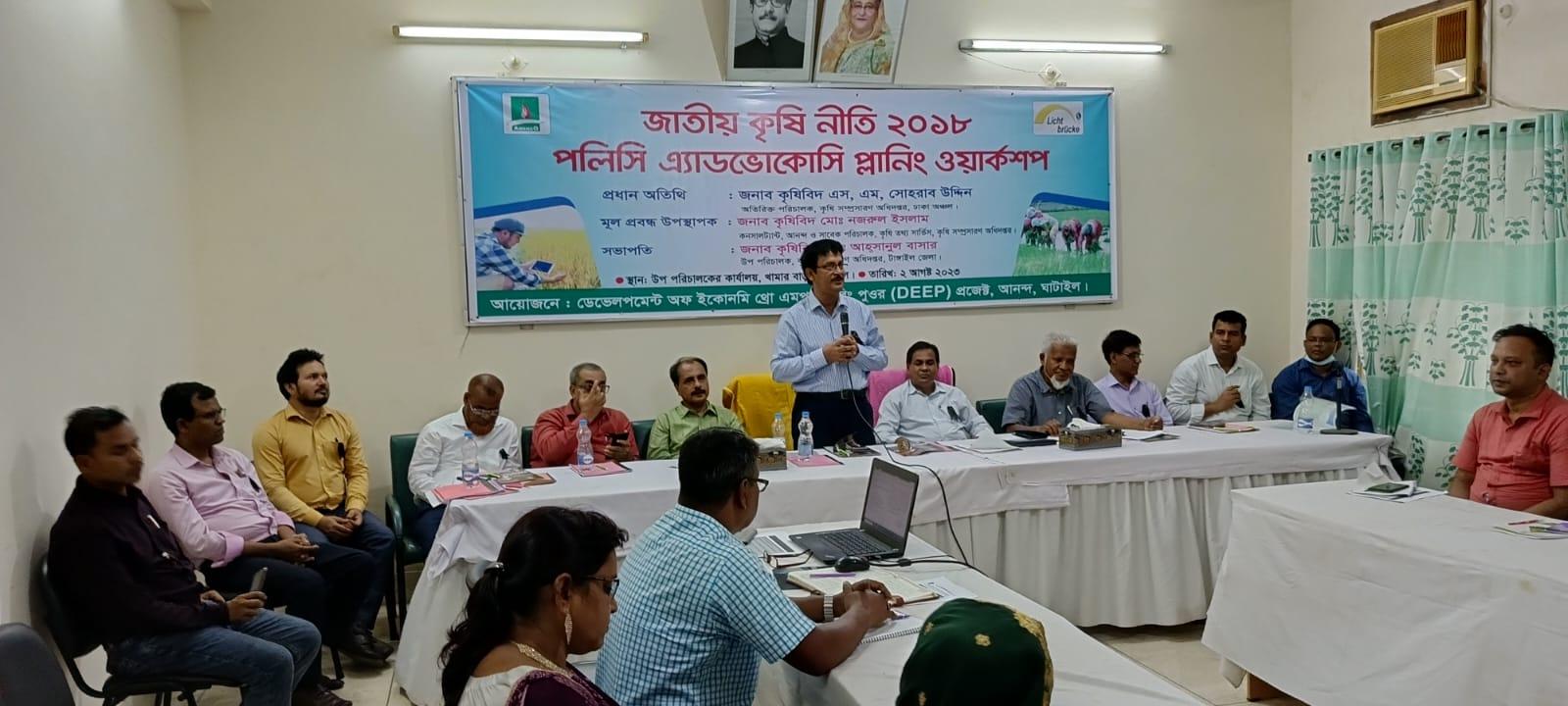
• Advocacy: Policy advocacy events engaging agriculture extension, women's affairs, youth development, Union Parishads and the Upazila administration to press for desired amendments to agricultural policy.
• Flood response: When the July–August 2024 monsoon flood damaged members' crops and enterprises, an additional BDT 1,375,000 in recovery support from the reserve fund was disbursed within months, protecting the project's hard-won gains.
Results at Project End
• 85% of women members reported being fully confident in running their associations independently, actively pursuing income-generating activities under their five-year development plans.
• 96% of farmers were producing and using organic fertiliser — reversing the earlier pattern of excessive chemical use, cutting production costs, and even generating income from selling surplus compost.
• 92% of farming households practised integrated pest management, and 88% adopted sustainable agro-technologies.
• 88% of member households engaged in value chain-based marketing of their produce and diversified income-generating activities spanning farm and non-farm sources.
• Households diversified their income beyond agriculture alone, strengthening resilience against shocks — a resilience tested and proven during the 2024 flood.
• The final report's formal self-assessment rated the project objective as completely achieved, with high sustainability across all four assessed dimensions — structural, economic, social and environmental.
Our Approach and Legacy
DEEP invested in institutions, not handouts. Every training, fund and market linkage was channelled through member-owned associations designed to outlive the project — with their own leadership, savings, development plans and, increasingly, formal cooperative registration. Notably, some farmers' associations declined external start-up loans in favour of funds they had built themselves through savings — a sign of exactly the self-reliance the project aimed to create. The shift to organic fertiliser and IPM leaves an environmental legacy alongside the economic one, and the model of association-based development has strengthened ANANDO's own institutional capacity, including a dedicated central MEAL function, informing the organisation's wider portfolio.